

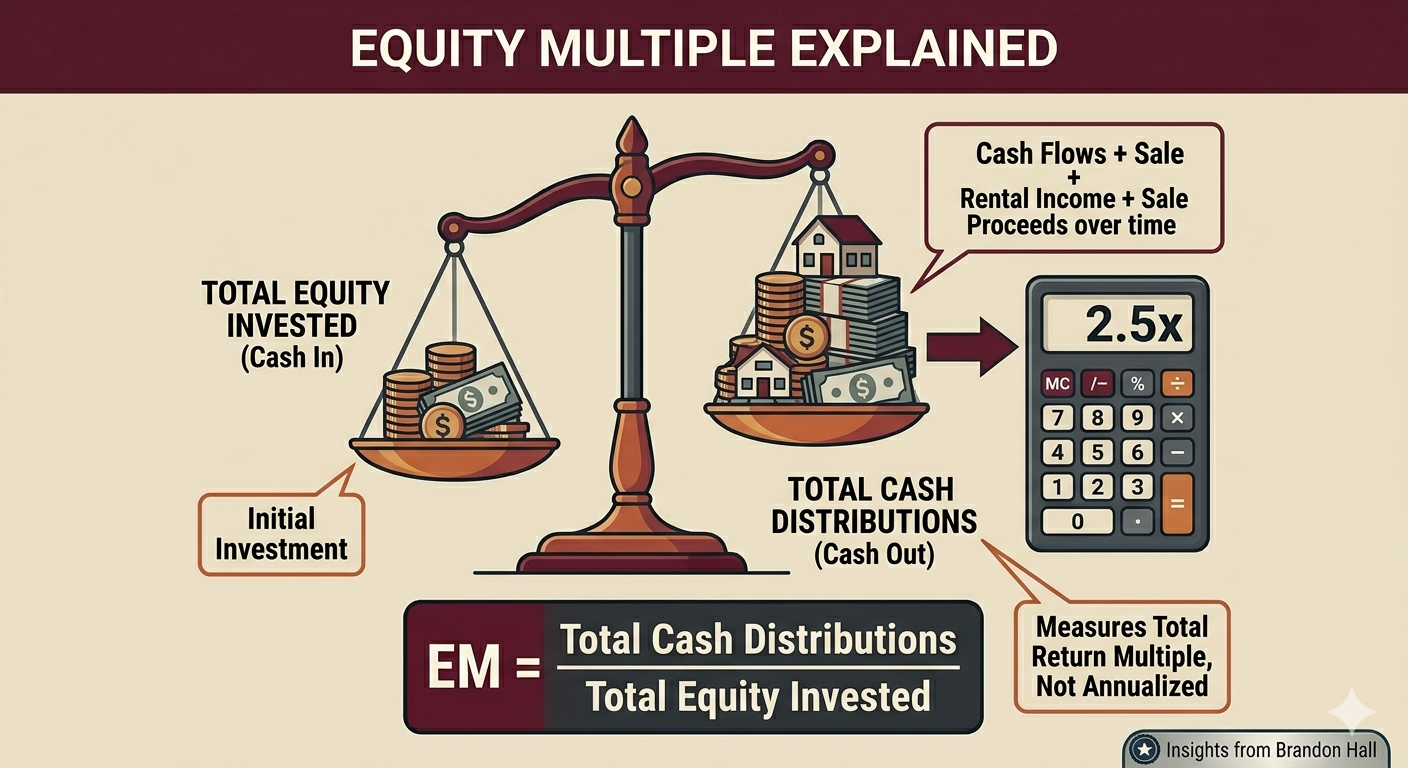
Equity Multiple, sometimes abbreviated EM, is a straightforward measure of an investor's return. It is simply the cash returned to the investor divided by the total investment.
Total Distributions / Total Investment = Equity Multiple
An investment with an Equity Multiple of 1.0 means that there was no gain nor loss on the investment, the investor simply got back their investment. An investment with an Equity Multiple greater than 1 indicates that the investor made money and conversely, an Equity Multiple below 1 indicates a loss on the investment. Below are a few examples:
Example 1
An investor makes an initial investment of $1,000. They receive $200 in cash dividends over the life of the investment and a final lump sum disbursement of $1,300. The equity multiple of this investment is 1.5 calculated using the following formula:
($200 + $1,300) / $1,000 = 1.5
Example 2
An investor makes an initial investment of $1,000. They receive $200 in cash dividends over the life of the investment which are reinvested. The final lump sum disbursement is $1,300. The equity multiple of this investment is 1.25 calculated using the following formula:
($200 + $1,300) / ($1,000 + $200) = 1.25
The drawback to Equity Multiple is that it doesn't account for the time-value of money. To illustrate this point, Example 3 and 4 below both have an Equity Multiple of 2.0. However, Example 3 is the more desirable investment as the investor would receive the total disbursements 7 years earlier.
Example 3
An investor makes an initial investment of $1,000. The investment distributes $500 in Year 1 and $1,500 as a final disbursement in Year 2.
($500 + $1,500) / $1,000 = 2.0
Example 4
An investor makes an initial investment of $1,000. The investment distributes $200 each year for 8 years and $400 as a final disbursement in Year 9.
($200 × 8 + $400) / $1,000 = 2.0
To mitigate the shortcoming of the Equity Multiple metric, investments should be evaluated using both Equity Multiple and Internal Rate of Return (IRR). Collectively these metrics provide the investor a clear understanding of the total return while also accounting for the time value of money.